
 Money Studio
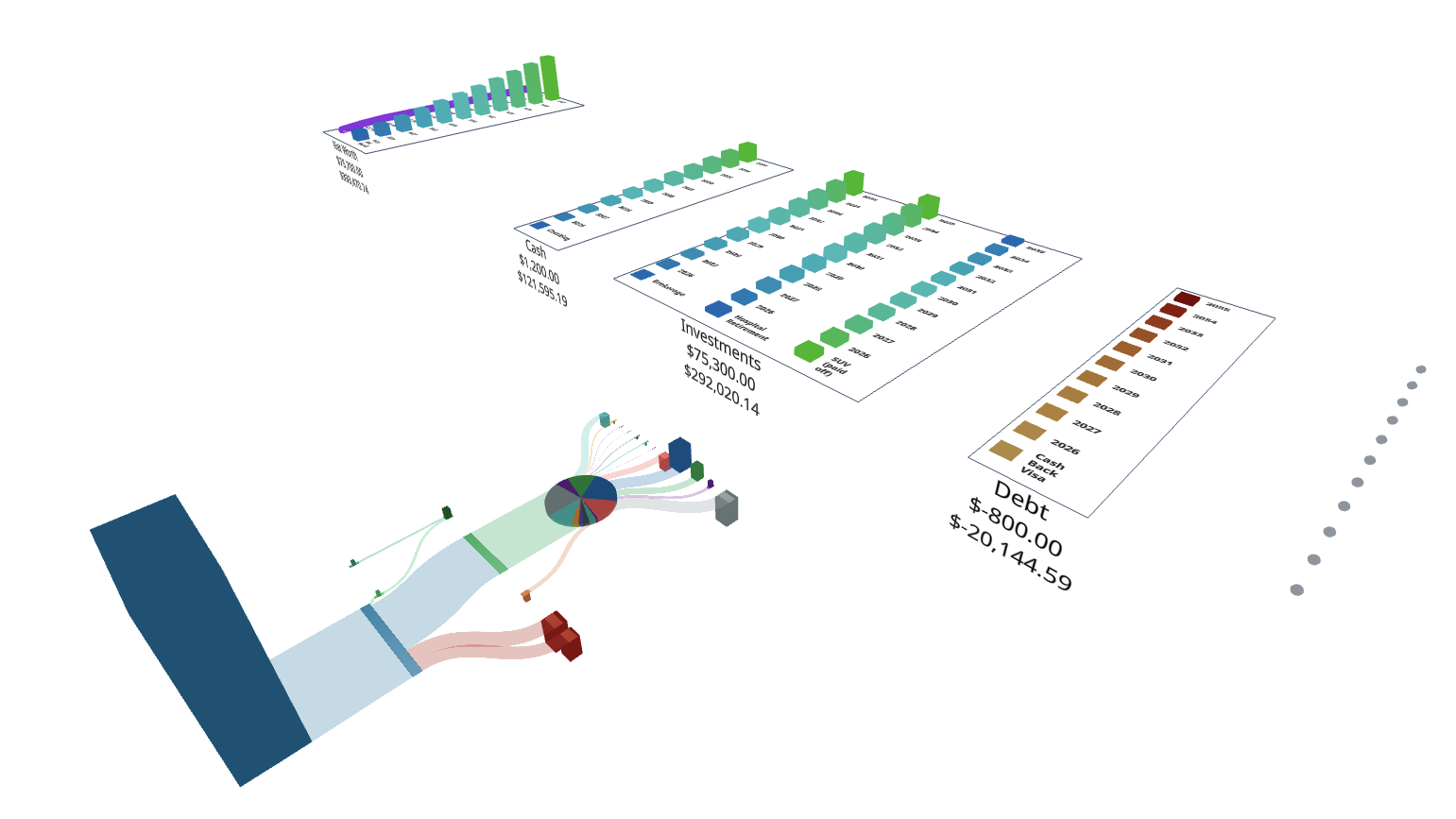
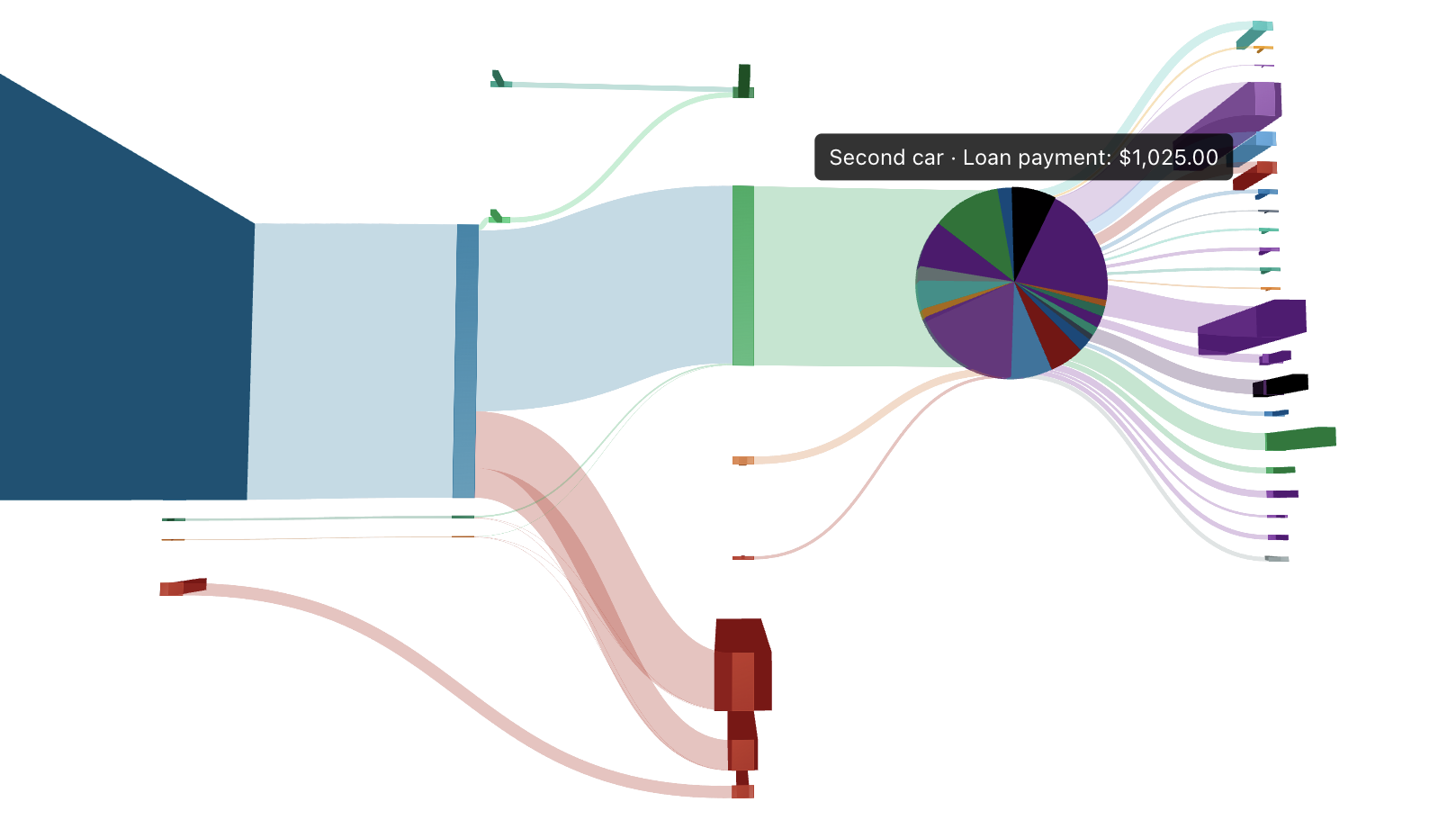
Money Studio is a financial visualization platform I am building from scratch as founder and principal engineer. The product vision is to make personal finance accessible to the financially under-served by letting anyone compose metaphor-driven visualizations of their household money - a plumber sees an excessive expense as a leaky pipe, a gardener sees it as an overhydrated flower. The platform follows an engine + marketplace model: I build the visualization engine and run the marketplace, while financial advisors, CPAs, and credentialed creators publish bespoke visualizations for their clients. The pattern mirrors Unreal Engine's asset marketplace, TSMC's foundry model, and AWS's infrastructure-as-a-service: consolidate an expensive undifferentiated base layer across an industry and let an ecosystem build on top.
The engine is approximately 80% complete and actively deployed at a private instance of money.studio. Every screenshot is live software, not a mockup.
Architecture Overview
The codebase is a TypeScript Yarn monorepo organized into workspace families covering the main application, shared libraries (types, UI components, CDK helpers, generated client and server SDKs), AWS CDK infrastructure, web and native client targets, and internal tooling. Every package is type-checked together in a single pass before any build, catching cross-package type regressions at CI time.
The application ships on five platforms from one shared codebase: a web app, a browser PWA, iOS (Capacitor), Android (Capacitor), and desktop (Electron and Tauri). A shared build pipeline generates Capacitor sync manifests for the mobile targets and Electron/Tauri packages for the desktop targets. Icons and splash screens are generated from a single source asset and distributed across all platforms via @capacitor/assets.
The Knowledge Graph
The on-device data layer is a knowledge graph where every financial entity - transactions, accounts, assets, debts, income streams, investments, crypto holdings - is a node and every relationship is a directed edge. Visualizations and formulas query this graph directly rather than coupling to a specific data schema, which means a single household model can power arbitrarily different dashboards without forking the underlying data record. The graph is augmented by an Event Ledger and a File System layer for audit history and document storage.
The Logic Editor
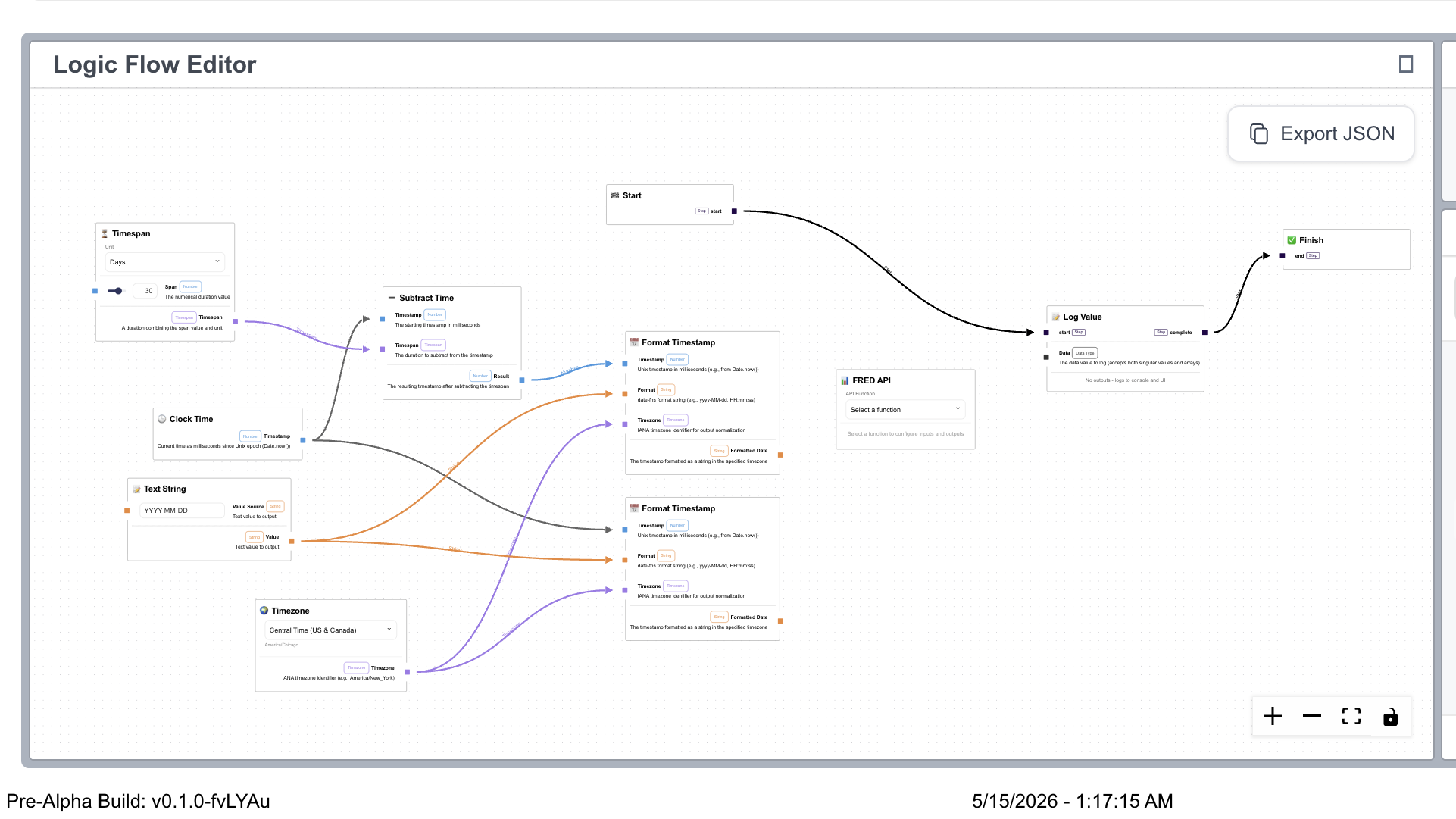
The creator-facing authoring surface is a node-based visual logic editor built on @xyflow/react. Creators wire together typed nodes representing data sources, formulas, transformations, and visualization outputs to compose new dashboards and metaphors for the marketplace - analogous to Unreal's Blueprint visual scripting system. Each node in the graph is a typed Device, drawn from a Device Library. The five engine surfaces (Summary, Data Access, Logic Editor, Designer, Debugger) are live and navigable in the current deployment.
Backend and Infrastructure
The AWS backend is defined entirely in TypeScript CDK. Infrastructure is decomposed into purpose-built CDK stacks covering global resources (WAF WebACL, ACM certificates), regional API delivery (API Gateway, CloudFront, S3, Route 53), user authentication (Cognito), and secrets and encryption key management (Secrets Manager, KMS). Lambda functions are organized by product domain and wrapped in an ObservableLambda CDK construct that co-deploys CloudWatch alarms and log groups as first-class infrastructure, so every Lambda ships with observability by default. A custom RequestAuthorizer Lambda enforces token validation on the API, and a scheduled EventBridge rule handles automatic token rotation. A type-safe client/server SDK is generated directly from the backend schema so every client call is fully typed end-to-end rather than made against raw endpoints.
Security
Security was designed in from day one rather than bolted on:
- SAST -
bearer scanruns against every library and application package at CI time, failing on critical, high, and medium severity findings. - SCA -
fossa analyzeaudits all open-source dependencies for license compliance and known vulnerabilities; the FOSSA badge tracks this continuously. - DAST -
observatory-cliruns against the locally hosted browser app and landing page endpoints. - IaC security scanning -
checkovscans all CDK-synthesized CloudFormation templates for misconfigurations. - OpenSSF Scorecard - the repository's supply-chain security posture is scored and badged continuously.
- WAF - a global AWS WAF WebACL is applied to all CloudFront distributions.
- Content protection - a custom Lambda authorizer validates app tokens on every API request; a scheduled Lambda rotates the underlying signing keys.
- Dependency integrity -
syncpackenforces version consistency across all monorepo packages. - Git hooks -
huskyenforces linting, type-checking, and security gates before every commit.
The cloud backup subscription line is intentionally designed to self-fund the SOC 2 audit cycle, AWS Security Hub coverage, and penetration testing, so the security investment scales with paying-customer count rather than as unfunded G&A overhead.
On-Device AI
The application ships an on-device AI assistant powered by @mlc-ai/web-llm, which runs quantized LLM inference directly in the browser via WebGPU/WebAssembly - no data leaves the device for the AI feature. Model weights are downloaded from HuggingFace, converted to the MLC weight format, and served locally.
The assistant is built on a custom RAG (Retrieval-Augmented Generation) pipeline that grounds every response in the user's actual financial data. A Snowflake embedding model (also served on-device via WebLLM, implementing the LangChain EmbeddingsInterface) vectorizes each financial entity as it enters the knowledge graph. Those vectors are stored in an RxDB vector store backed by encrypted IndexedDB (Dexie adapter, wrapped in key compression and CryptoJS encryption), so the vector index is persistent, private, and fully local. At query time, the user's question is embedded with the same model and the top-K most semantically similar knowledge graph nodes are retrieved via cosine similarity - surfacing contextually relevant accounts, transactions, debts, and projections without any keyword matching.
A templated prompt system then assembles the response context. A fillTemplateWith function resolves LangChain-style {{variable}} tokens (model, provider, language, timestamp, input) against configurable per-session templates. For RAG-enhanced queries a dedicated createRAGPromptTemplate function structures the payload into explicit User Prompt, Financial Context, and Response sections, giving the model a consistent and legible format to reason over user-specific financial data. Session memory is managed as a layered stack - a long-term summarization pass, a sliding short-term context window, and optional injected system personas - all token-budget-aware. A separate Python toolchain (build_rag_db.py) uses Chroma and sentence-transformers to build static reference knowledge bases from financial markdown documents during development, enabling offline testing of the retrieval pipeline against curated content before deploying against live graph data.
A prompt-engineering-explorer workspace provides an internal tooling surface for iterating on system prompts and RAG templates against the on-device model.
Web3 Integration
The application integrates with five Web3 wallet connectors (@web3-react/core, MetaMask, Coinbase Wallet, Binance Smart Chain, Phantom, Gnosis Safe) to allow users to include crypto holdings in their financial graph.
Cross-Platform Build Pipeline
A single yarn build command: type-checks all packages, generates the backend SDK, builds the browser PWA, syncs Capacitor for iOS and Android, packages Electron for macOS and Windows, and generates icons/splash screens for all targets. The CI pipeline (GitHub Actions) separates non-prod managed deployments (on merge to main) from prod releases (on tagged release), with CDK synth and deploy stages gated behind type-check and test passes.
Tech Stack
TypeScript · React 18 · Redux Toolkit · React Router · @xyflow/react · Capacitor (iOS & Android) · Electron · Tauri · AWS CDK · API Gateway · Lambda · CloudFront · S3 · WAF · Cognito · Amplify · Secrets Manager · EventBridge · Route 53 · ACM · CloudWatch · WebLLM (@mlc-ai/web-llm) · Web3-React · Yarn Workspaces (Monorepo) · GitHub Actions CI/CD · Bearer (SAST) · FOSSA (SCA) · observatory-cli (DAST) · Checkov · OpenSSF Scorecard · dotenvx · syncpack · Storybook